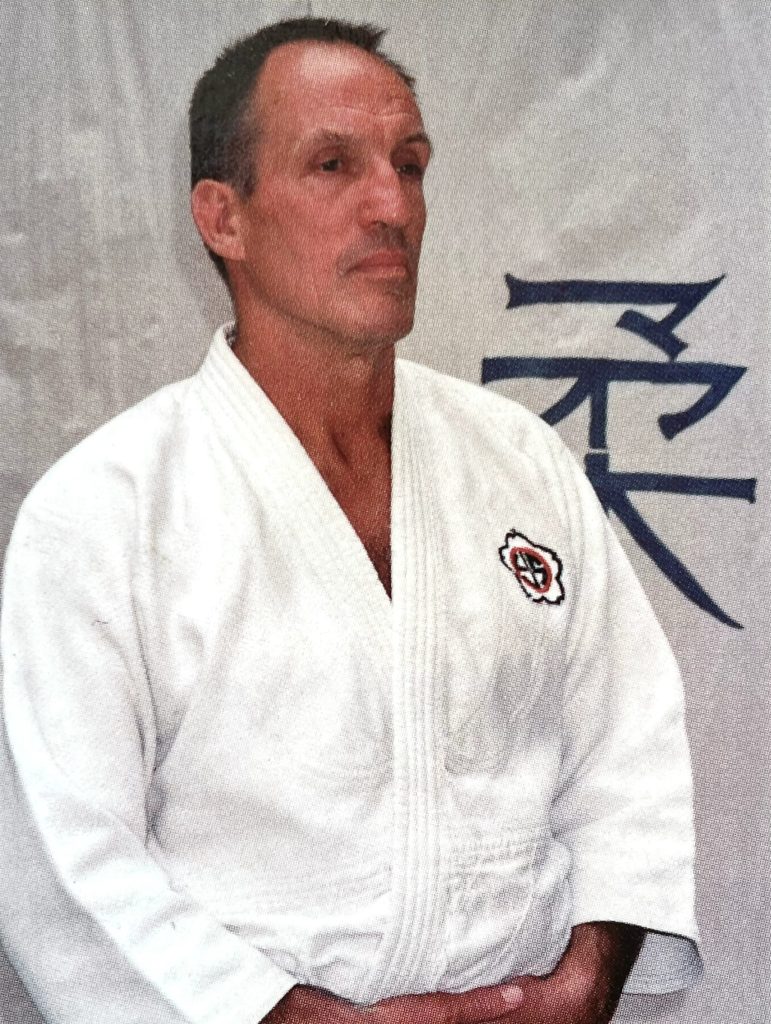
Syd Hoare was born in Paddington, London in 1939, the eldest son of Alfred Hoare, who worked for the Ministry of Defence, and Petrone Gervelute, a waitress. At the age of 14, Syd came across a book on jujitsu in his local bookshop and asked his parents if they could buy him judo lessons for Christmas.
From his first visit to the Budokwai – Britain’s premier judo club – in February 1954, Syd was fascinated by the sport. Under the tutelage of Gunji Koizumi, Teizo Kawamura, Trevor Leggett and others at the Budokwai, Syd trained intensively, and within 18 months he won his Black belt against adult opposition. His promotion to Black belt at the age of 16 was the youngest ever in the UK. At 17 years old Syd was captain of the London Area team that won the National Area Team Championships. In the same year, 1957, he was selected to represent Britain in the European championships. However, military service was still compulsory for men in the UK, and in March 1957 Syd joined the Middlesex Regiment at Inglis Barracks in Mill Hill, north London. Syd completed three years in the army, serving in Cyprus and Germany. This was a frustrating period as opportunities to practise judo were limited, but Syd worked hard to maintain his physical fitness, training in gymnastics, swimming and weightlifting among other sports.
On leaving the army in 1960, Syd resumed frequent judo sessions at the Budokwai. He gained his 2nd and 3rd dan, and was selected to represent Great Britain against France at the Royal Albert Hall for the London Judo Society show. Syd fought in the London Area team, which again won the National Area Team championships. In December 1960 Syd attained his 3rd dan and in 1961, at the age of 21, he set sail for Japan, where he trained for nearly four years.
His time in Japan had a profound influence on Syd. He became fluent in the language and developed a deep knowledge of and respect for Japanese history, culture and sport. In Japan, Syd trained at the Kodokan, Keishicho and Nichidai clubs in Tokyo and attained his 4th dan. In 1964 he returned to the UK and was selected to represent Britain as a middleweight in the Tokyo Olympics of 1964. This was judo’s first appearance in the Summer Olympics, and Syd was therefore now a member of the first ever British judo team, alongside Brian Jacks (lightweight), Tony Sweeney (heavyweight) and Alan Petherbridge (open weight).
Syd fought in the British team from 1964 to 1968. In 1965 he won the silver medal in the open weight category of the European championships. He retired from active competition in 1968 and was appointed Chief Instructor of the Budokwai. From 1968 to 1971 he read Japanese at the School of Oriental and African Studies (SOAS) at London University, acquiring his honours degree, and later did three years postgraduate research into Japanese Buddhism.
During his time as Chief Instructor at the Budokwai, Syd trained many young competitors to Olympic medal standard, European gold medal standard and British championship level. He went on to become a national coach and examiner, chairman of the British Judo Association and director of his own club, the London Judo Society.
Syd first got interested in sumo while in Japan, attending tournaments and observing training. He founded the British Sumo Association in the late 1980s (now the British Sumo Federation), and in 1990 set up a sumo training section at his London Budokan club (formerly the LJS). Syd arranged for Nathan Strange to travel to Japan and train professionally in a Japanese heya or sumo stable, the first European to do so. The Japan Sumo Federation invited Syd to bring a three-man British sumo team to the next international sumo championships at the Kokugikan, the home of professional sumo in Tokyo. The team, consisting of Steve Pateman, Bill Etherington and Larry Stevens, beat two Japanese prefectural teams but went on to lose in the third round. Bill placed third in the individual championships. The team’s journey to Japan for the competition was the subject of a BBC documentary, Three Big Men, in 1993.
When the International Sumo Federation was later set up, organising world sumo championships, Syd was appointed Vice-president of the Federation and awarded his 5th dan in sumo.
Syd wrote several books on judo, fitness and self-defence, beginning with Teach Yourself Judo, which was published by Hodder and Stoughton in 1980 and culminating with his two self-published volumes, A History of Judo (2009) and his autobiography, A Slow Boat to Yokohama (2010). Syd commentated on several sports including judo, sumo and wrestling for Eurosport, ITV and Channel 4. From 1995 to 2007 Syd commentated on 72 sumo tournaments and over 16,000 individual bouts for Eurosport. He made brief appearances on TV shows such as ‘You Bet’, ‘TGI Friday’ and the ‘Jonathan Ross Show’, and played minor roles in several films including Guy Ritchie’s Snatch, the sumo wrestling film Secret Society, and Kenneth Branagh’s As You Like It in 2006. He also appeared in the music video for Meatloaf’s ‘Rock and Roll Mercenaries’.
Syd married Sophy Fox (née Haslam) in 1973, and they went on to have four children; Sasha, Jocelyn, Zoe and Max. After his divorce from Sophy, Syd later married Oksana Khoutornaja and had two more children, Viviana and Rafferty. In the last years of his life, Syd sadly suffered from frontotemporal dementia. He died in 2017, a much-loved father, grandfather and husband, and inspiration to countless students of judo and sumo.
An excerpt from A Slow Boat to Yokohama
Eight weeks after Christmas on the evening of Thursday, the 25th of February 1954, I travelled to Victoria by tube and after a short walk found the Budokwai at 16 Lower Grosvenor Place, right next to the high rear perimeter wall of Buckingham Palace. It was dark and slightly foggy when I arrived, and the gas lights barely illuminated the street. The Budokwai was in a shop in an anonymous small parade and occupied the basement and ground floors. The shop front was quite dark, but by the front door I could make out a large tarnished brass name-plate in the shape of a cherry blossom with a swastika like design in the middle. It increased my unease.
Beneath it was written “The Budokwai’. I went into the reception area, which was also dark and cluttered, and noticed a most peculiar smell that made my nose wrinkle. I had read about Chinese opium dens and half expected the worst as I pushed the door open. The smell, I discovered later, was a mixture of sweat and army surplus foot powder, of which the club had a huge supply.
A long wooden counter stretched into the depths, and behind it, in the gloom, a motionless figure stood. As I went in I was also struck by the peculiar sounds coming deep from within the building. These were muffled thumps, bangs and distant cries like those of lost souls in deep underground dungeons. This close to the end of the [Second World] War the Japanese had a reputation for being cruel people and ready to fight to the death. They despised anybody who was not prepared to do the same. I shivered and wondered what I had let myself in for.
As I approached I was made even more nervous as the person looked at my receipt and barked, ‘You’re late!’ He rummaged around under the counter, pulled out a white folded judo suit and almost chucked it at me. This, I soon discovered, was Percy Sekine – the beginners’ course instructor. He was a small man of about 5’6″; weighing perhaps eight stone, and was of Japanese and British parents. His wife was the daughter of Gunji Koizumi the Budokwai founder. Percy was also an ex-British judo international. Like many of them in that club he had quite a history. Later I learned that during the war he had made one of the great classic escapes from a German prisoner of war camp, along with another London judo man called Eric Dominy […]
In the first lesson Percy demonstrated how to fall safely, how to hold our partner and how to move around the mat. ‘Never’, he warned us, ‘cross your feet or stand with your feet too close together. Most of your weight should be on the balls of your feet with the back of the foot just brushing the mat’. After that he showed us a couple of throws, a thirty-second ground immobilisation hold, one armlock and one strangle (each was representative of the four main ways of defeating an opponent). Then he selected the biggest man in the class, threw him to the mat and pinned him to the ground. The man, who must have been about fifteen stone (95 kg), was ordered to get up. He struggled in vain as his face turned bright red, and all the while this poor unfortunate man wriggled beneath Percy’s diminutive form. Percy instructed us nonchalantly in the details of the hold, ‘Tuck his arm tightly under yours, lean on the floating ribs – that will restrict his breathing, take your right arm round his neck and lift his head off the mat, spread your legs wide, then make sure you stay on top – like riding a horse.’ From this hold he casually moved on to an armlock, and the man yelped in surprise. My mouth fell open. This, as my jujitsu books had said, was indeed how the small man could beat the bigger man. From that moment on my appetite for judo was insatiable, and I started to live it night and day.
Click here for Syd’s entry in the Oxford Dictionary of National Biography (account needed).


You must be logged in to post a comment.